



As I write this, Avengers: Endgame is pummelling the box office. The three-hour onslaught that found our damaged group of heroes — the ones still alive after Thanos (Josh Brolin) snapped half the world’s population into oblivion — attempting to acclimate to this new reality and find some healing along the way, not only leaned heavily on Captain America (Chris Evans) and Iron Man (Robert Downey, Jr.) working to get the band back together, the movie went all-in on the daddy drama.
From the murderous grief spiral Clint “Hawkeye” Barton (Jeremy Renner) finds himself drowning in to the domestic uptick Tony Stark’s life takes in the woods to Scott Lang’s (Paul Rudd) heroic return to his daughter, audiences got a peek at the more human side of some of the Avengers most relatable members. But as much as their dad lives are brought into focus, Avengers: Endgame still does fatherhood wrong.
Since day one, Hawkeye’s modus operandi has been to protect his family at any cost, which was an issue held much closer to the vest than that of the rest of the Avengers crew. Sure, maintaining order in the world — and, for Captain Marvel (Brie Larson), the universe — is what makes the Avengers a force to be reckoned with. But as soon as someone like Barton or Lang or Stark suffer the pangs of fatherly love and loss, a whole new set of heartstrings are suddenly exposed for the plucking.
At the same moment in time that found Tony Stark and Steve Rogers surviving the attack, which turned the likes of Peter Parker (Tom Holland), T’Challa (Chadwick Boseman), Wanda Maximoff (Elizabeth Olsen), Stephen Strange (Benedict Cumberbatch) and more into literal flecks of dust, floating away in the wind, Barton was living a humble existence hundreds of miles away on his quaint plot of land.
He may have been absent throughout the cataclysmic events that transpired in Infinity War. He may have been removed, completely by choice, from the devastating battle with Thanos that led to that now infamous moment … the Snap heard — or unheard, depending on which side of the snap you landed on — around the world.
The unexpected disappearance of his family, seemingly right before his eyes, was a system shock for Barton. Separated from the Avengers lifestyle, he lacked any sort of support system to help him through this dark time. Losing his loved ones sends Hawkeye down the darkest path, with Endgame giving audiences a dreary perspective of the “Ronin” persona he takes on in the comics, as he pivots to the shadows as the relentless hooded assassin.
Hawkeye’s quest for unrequited vengeance is like other recent genre father tales we’ve seen on the big and small screen. His story arc dips into some irresponsible Frank Castle (Jon Bernthal) territory at times, but Hawkeye is not The Punisher and thankfully Avengers: Endgame offset his bleak plot points with the levity of Scott Lang’s continued Ant-Man storyline and the catharsis that eventually came from Tony Stark’s soul-stirring sacrifice.
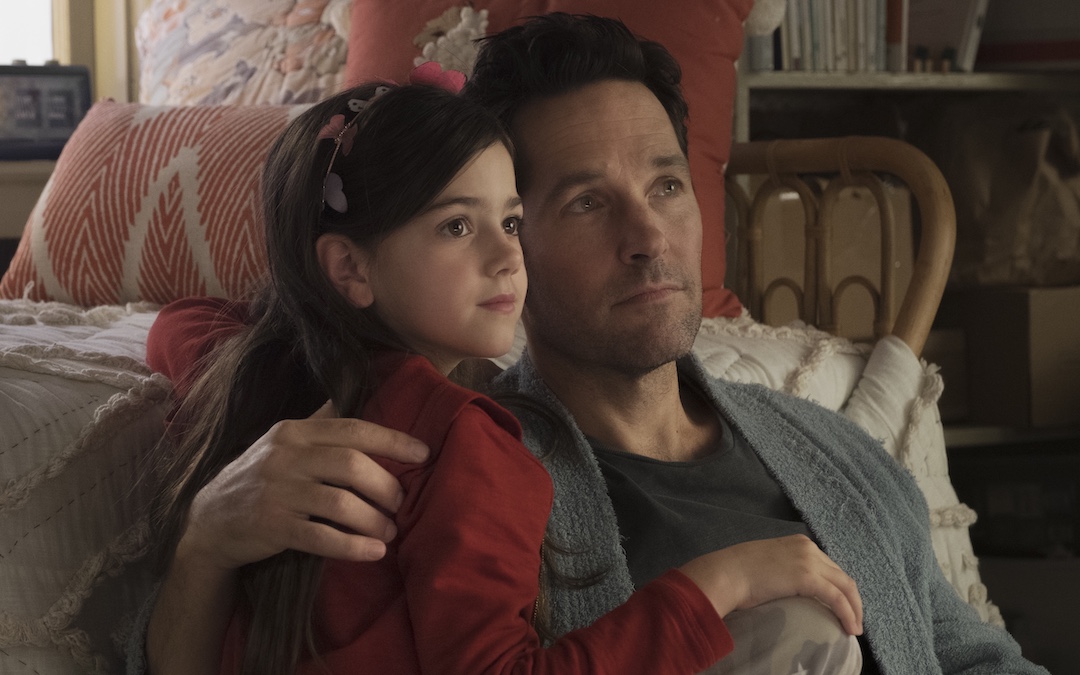
Lang’s participation in Endgame kick starts the gang’s bonkers-sounding “Time Heist” plan into action, sending them all back in time to retrieve the Infinity Stones with the goal of resetting things where they should be, bringing to life those who perished, while also finding retribution with Thanos and his thugs. His appearance, though, also brings back the endearing parental element from the Ant-Man movies. We’ve watched Scott this long and if it’s one thing that is a constant in his life, it’s the bond he has with his daughter Cassie.
Upon returning from the Quantum Realm five years after Thanos’ attack, we watch as Lang is finally reunited with his teenage daughter (this time played by Emma Fuhrmann) — and that moment surely packs an emotional punch.
The heart-breaking recognition in Scott’s eyes, as he knocks on the house’s door, that he’s missed so much of Cassie’s life, is one that any divorced parent sharing custody can truly understand. If it’s one thing this Time Heist cannot fix, it’s the number of years Lang has been separated from his daughter. Still, she survived Thanos’ attack, which gives Lang a fatherly baseline in the overall story — acting as the middle ground between Hawkeye’s painful loss and Tony’s second chance at life.
For Stark, the amount of foreshadowing in Avengers: Endgame is ridiculous. From the very beginning of the film, there are multiple fakeouts alluding to Iron Man’s death — his lethargic goodbye message to Pepper (Gwyneth Paltrow) made us prepare for the worst. And yet, for a man who has made a reputation for putting his own interests first, dying in space was enough for Tony to break from the Avengers pack and go his own way.
Five years later, Steve and Natasha (Scarlett Johannson) may be struggling to maintain their own place in this shell of a world, but in a cabin by a pristine-looking lake, Tony and Pepper have forged a new life. We never thought we’d see Tony Stark father a child, although his mentor-student relationship with Peter Parker helped us warm up to that idea. Heck, if it wasn’t for that relationship, we’re not even sure Tony would’ve been in the emotional position to even consider having his own family to begin with. Not only does having a daughter of his own give Tony some grounding, but it’s also, in his words to Steve, Natasha and Scott, “his second chance.”
The bond Tony created with Peter seemed to echo the connection Stark never truly had with his own father. So, of course, Endgame gives him that little gift, too. As Tony and Steve travel back to 1970 to retrieve more Pym Particles, in order to complete their “Time Heist” mission, Stark comes face-to-face with Howard (John Slattery), his father. It’s an endearing, heartfelt moment that gives us a rarely-seen version of Tony Stark — he’s tongue-tied and flustered, resorting to following Howard around like a puppy in need of approval. And he passively gets it, along with a hug, as the two men discuss their own anxieties surrounding fatherhood.
From my own personal perspective, this part of the movie packed the deepest punch. I never knew my father and, as a new dad myself, there are questions I’ll never have answered about where I come from. Or why he made the choices he made. Of course, these issues are commonplace and lend themselves to the overall expectations society puts upon fathers — as well as the stresses and pressures men may put on themselves.
And yet, when Tony tells his father that “he only remembers the good stuff” regarding his own upbringing, their conversation sort of backs up a dad trope explored too often in pop culture entertainment. More often than not, dads are presented as a thing that happens to a character, as opposed to a well-rounded role model themselves. The MCU is full of this trope, too, with the likes of T’Challa, Bruce Banner (Mark Ruffalo), Peter Parker, Star-Lord (Chris Pratt) and Thor (Chris Hemsworth) all being products of the actions or their dads, instead of fully fleshing out the fathers as developed present characters, themselves.
Unfortunately for Tony, his character ends up falling into that category here. Yes, he ended up making the ultimate sacrifice to save mankind, losing the family life he never knew he coveted, in the process, by using the new-and-improved Infinity Gauntlet to snap Thanos into oblivion. And for that, he’s obviously the end-all, be-all of what heroism means in Avengers: Endgame. But his decision to destroy Thanos will likely stay with his daughter for the rest of her life until she, too, views her father as this tortured mythical being she only has random fractured memories of.
The broken dads of the MCU: The saga continues.
“With great power, comes great responsibility.” These words from Stan Lee, the father of the Marvel Cinematic Universe, ring true on multiple accounts. Yet, Avengers: Endgame, for the most part, ignored its responsibility in addressing the MCU’s daddy issues. I personally believe the duty that comes with being a dad is far greater than any Avenger, living or dead, has yet to embody. Here’s hoping the future of the franchise will continue to right that wrong.


