



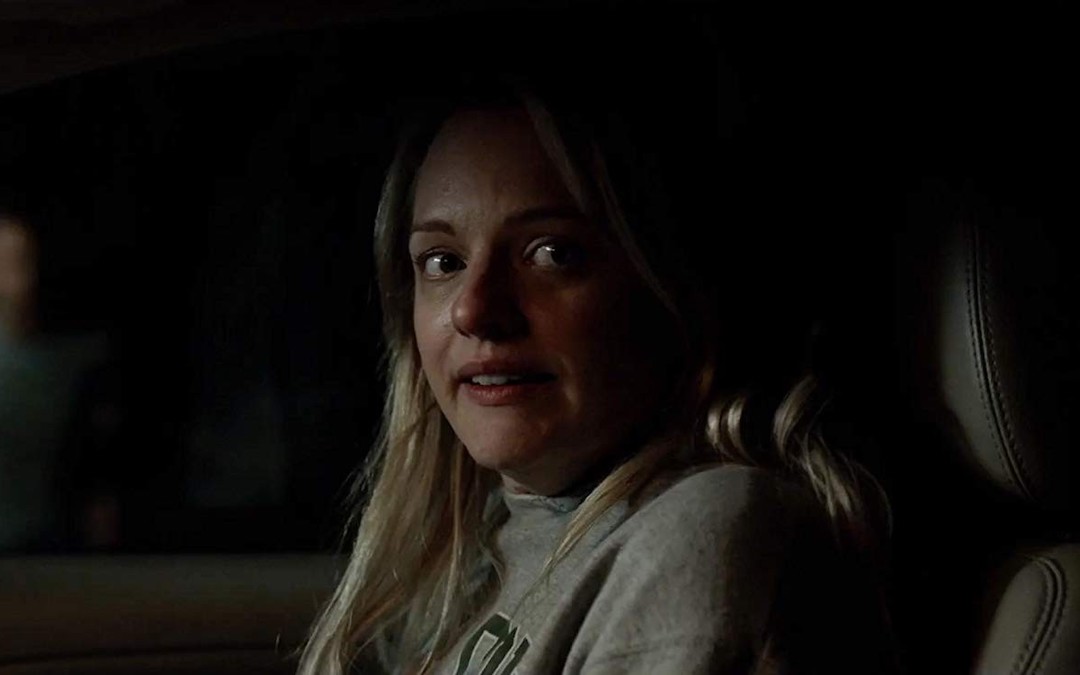
Here at Atom, we love movies. We especially love to dive into the behind-the-scenes and how-did-it-get-mades of filmmaking, which is often as fascinating as the films themselves. There’s nothing like watching a movie that captures your attention, moves you, makes you think, or simply helps you escape your worries for a few hours. While it takes a group effort from the lowliest grip to the assistant director to bring a movie to life, it’s the actors on screen who are our entry point into any film. The best actors make it look effortless; too often we take for granted just how much work it takes to make it appear that way, just how much talent we’re privileged to witness.
Our new regular column celebrates the actors we love to watch by exploring the scenes that illustrate just how great they are at what they do.
In honor of her latest movie, The Invisible Man, crushing the box office this past weekend, this week we’re breaking down: Elisabeth Moss.
1. ‘Her Smell’ – ‘Heaven’ Cover Scene
The setup: In Alex Ross Perry’s indie Her Smell, Moss plays Becky Something, a near-has-been punk rock musician who is drunk and high more often than she’s sober. She struggles to get sober while trying to recapture some creative inspiration and be a more stable force for her daughter. In this scene, when Becky is at one of her lowest points, her daughter asks her to sing a song that reminds Becky of her and Becky obliges with a stripped-down cover of Bryan Adams’ “Heaven.”
Why she’s so good: It should be noted here that Perry actually wrote in the script for this scene, “This is the best performance of ‘Heaven’ you have ever heard or will ever hear,” and indicated it would be a one-shot take. No cameras cutting away and splicing in someone else’s hands, no one else playing the piano. It’s a daunting task for any actor, let alone one who isn’t trained in singing or piano. But Moss uses that vulnerability to her advantage here, turning in a performance that is both raw and fragile. All of Becky’s tenderness for her daughter and all of the heartache of her difficult life play out on her careworn face. It’s a simple, quiet moment – just Moss’s soft voice and a piano – but one that is mesmerizingly powerful in its intimacy.
2. ‘Top Of The Lake: China Girl’ – ‘A New Lead’ Scene
The setup: Okay, I admit, this isn’t the clip I wanted. The clip I wanted was actually from Top of the Lake Season 1 (which was a far stronger season), but alas, I could not find it anywhere. Instead, I chose this clip from Season 2 of the procedural, which is in the vein of Broadchurch and True Detective and co-created by Jane Campion. Moss plays Robin Griffin, a driven, ruthless detective and Gwendoline Christie plays Miranda, her new partner. In this scene, they’re clearly not used to working one another yet as they interview a witness and the tension is palpable.
Why she’s so good: Elisabeth Moss is known for showing her vulnerability in roles, often crying until her mascara is smeared and makeup runs down her face. But Robin gives her a chance to fully show off her nonverbal acting, using her facial expressions to tell an entire story and give a full character sketch in just over a minute: Calculating, someone who likes to be in control and doesn’t like surprises. She slowly stalks closer to the witness as she lets him talk, clearly waiting for him to hang himself, watching him like a wolf eyes a deer straggling behind the herd. Miranda jumps ahead of her and reveals a crucial piece of information and frustration clearly plays over Robin’s face as she struggles to maintain her composure. It’s over in but a moment, but it’s a look that says so much: She has a specific way of doing things; Miranda derailed her flow; now Robin is pissed but trying not to show it. Moss tells an entire story and sketches her character with just an eyebrow raise and a delayed turn back to the witness.
3. ‘Mad Men’ – Peggy Turns In Her Notice To Don
The setup: No character on Mad Men had as dynamic an arc as Elisabeth Moss’s Peggy Olson. Starting out as a sweet, shy girl in the secretarial pool, over five seasons Peggy made the jump to copywriter at the advertising firm, then creative exec, finally rising to become Don Draper’s right-hand woman. This scene is one in which she finally realizes she’s grown beyond what Don can offer her and she makes the personal and career decision to take a job offer elsewhere. However, it’s not easy to leave her mentor and the man who taught her all the knows.
Why she’s so good: This scene is vintage Elisabeth Moss, an actor who so often plays women who push against the status quo, who are a type of outspoken bold wrapped around a core of vulnerability. Often, they’re held back from their full potential. But not with Peggy Olson. Moss shows how much Peggy has grown here, refusing to wilt under the face of Don’s passive-aggressive reaction to her leaving, remaining strong even when he purposely tries to hurt her by telling her to leave immediately. Only when she gets close enough to him that he can’t see her face does her facade break. In a voice thick with tears, she tells him not to be a stranger and Moss reveals just how much this is costing Peggy even as she suppresses her character’s emotions. It’s true that writers shape the character, but it’s the actors who inhabit them that bring them to life. Rarely has this been truer than with Peggy Olson.
4. ‘The Seagull’ – ‘Loving Without Hope’ Scene
The setup: A 2018 remake of the Anton Chekhov play of the same name, The Seagull follows the romantic and artistic entanglements within a small circle of the Russian intelligentsia at the end of the 1890s. Moss plays Masha, daughter of the managers of the estate where the action is set, and horribly depressed that the young writer, Treplev, doesn’t return her love for him. Instead, she resolves to marry the dull and poor schoolteacher, Medvedenko, not out of love, but out of desperation to get her mind off Treplev’s rejection. Obviously, this is not the best plan.
Why she’s so good: Ah, Masha. Perhaps the world’s first goth. There is often a sly, tongue-in-cheek humor to Chekhov’s work and Moss understands this intimately. Masha is no doubt tragic and sympathetic, but Moss nonetheless plays her with a wink and a nod, embracing the melodramatic and slightly ridiculous nature of the character even in the middle of tears. Moss pulls out all the subtext inherent in Chekhov’s work and weaves it throughout her performance of the jilted would-be lover. It’s a scene in which she’s dramatic without being campy, sympathetic while still being absurd, aware of her own absurdity but without hope. And all of it overlaid with the veneer of quiet desperation. The movie itself may have received middling reviews, but Moss is electric and the only one to truly nail the tone of Chekhov.
5. ‘The Handmaid’s Tale’ – ‘You Are Not In Charge. I Am.’
The setup: By now, you likely know the general premise of The Handmaid’s Tale: In Gilead, a dystopian former part of America, birthrates have plummeted and its totalitarian regime has forced all fertile women into sexual slavery. Women are nothing more than vessels for babies, and the sexual slaves seen as the property of their masters. Moss plays Offred, one of those slaves. By the third season, she has cast off her slave name and retaken her name of June, as well as becoming more bold and assertive in her zealous goal of helping children escape Gilead, going so far as to directly talk back to her owner, Commander Lawrence.
Why she’s so good: Consider this the tightly-controlled rage of every woman who has ever been sick of men telling her what to do, how to dress, how to look, where to go, that she’s too emotional, too much, too fat, too thin, who has spoken over her at a meeting, taken the credit for her ideas, negged her, cheated on her, raped her, hit her, and then taken back her power from those men. Moss’s pointed fury is palpable as she bites off the words, “I am not. doing. that,” every single line whipped at scene-mate Bradley Whitford with the force of a throwing knife. The look she turns on him when he imperiously tells her that he’s made his decision is what cements the reality of their relationship: She’s really the one in charge and is about to soundly relieve him of the mistaken belief he is. Haughty, dripping with disdain, utterly unimpressed by his facade of still being the one with the power, as she slowly rises from her chair to stare him dead in the eyes, you can feel the dynamic shifting, so tangibly does Moss take over the scene.
If you want to see the great Elisabeth Moss in her latest, The Invisible Man is currently in theaters. Get tickets here.


